Vaulted Ceiling Repipe Planning for Coto de Caza Homes

Tall, open ceilings change how new supply lines can be routed. Here is what Coto de Caza owners of homes with vaulted ceilings can think about before a repipe.
Vaulted and cathedral ceilings give a home an open, airy feel, but they also change what sits above the rooms below. Without a flat attic over every room, there are fewer easy paths for running new supply pipes. This guide covers Coto de Caza vaulted ceiling repipe planning in general terms, so owners know which questions to raise early. If you are considering a vaulted ceiling repipe in Coto de Caza, understanding how your roof framing shapes pipe routes is a good first step.
Why vaulted ceilings matter for pipe routing
In a home with a standard flat ceiling, the attic above often provides open space for routing pipes from one end of the house to the other. A vaulted ceiling follows the roof line, so the space between the ceiling and the roof may be only as deep as the rafters. That space is usually packed with insulation and sometimes divided by blocking.
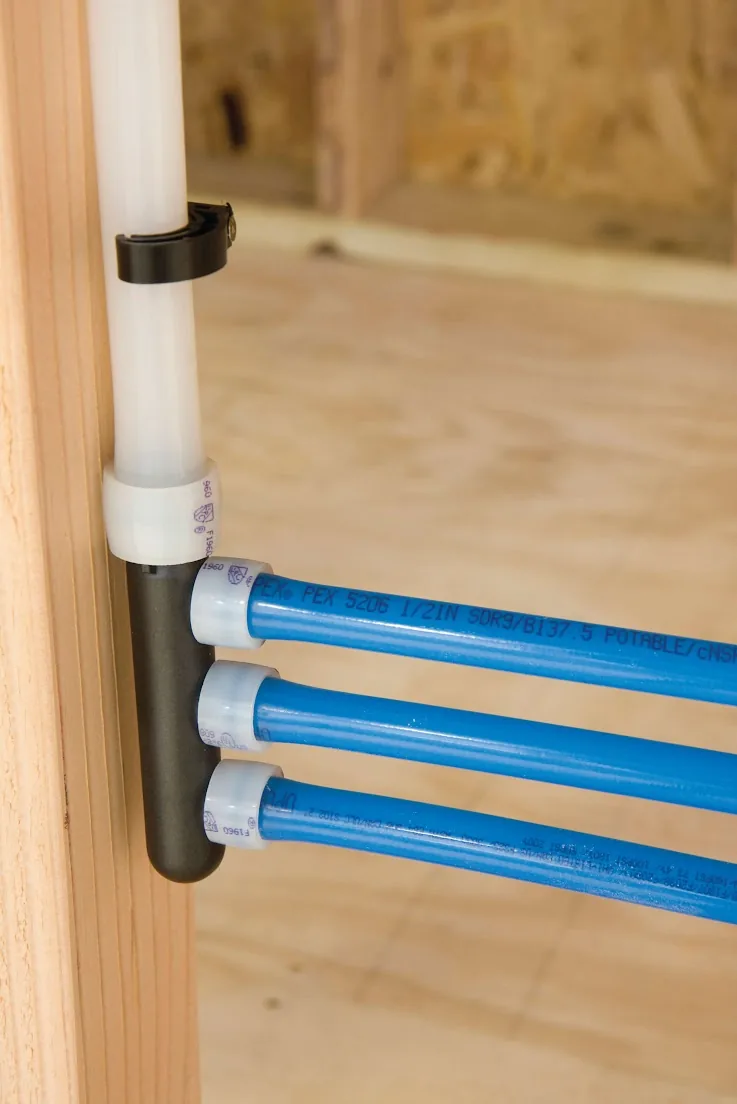
As a result, piping for rooms under a vault may need to travel through interior walls, floor systems, soffits or chases instead of across an open attic. Every home is different, which is why a walk-through matters before any plan is set.
Questions for the walk-through
Before any plan is set, it helps to have answers to a few basic questions. Where is the attic access, and how much of the house does it reach? Are there two-story sections with floor framing between levels? Which bathrooms are farthest from the water heater? Are there finished ceilings with beams, wood planks or special textures that should not be opened? Sharing original plans or remodel drawings, if you have them, can speed up this step and make route options easier to compare. It also helps to note any past leaks, since their locations can show where older pipes run.
Common routing options
Depending on the layout, a plumbing contractor may look at several possibilities:
- Running lines through interior walls that connect to an accessible attic area elsewhere in the house.
- Using the floor system in two-story sections, where joists create space between levels.
- Building a small soffit or chase in a closet or along a wall where it will not affect the look of the room.
- Using a garage ceiling or crawl space, where one exists, as a main pathway.
Each option has trade-offs in wall openings, finish work and pipe length. Asking how each route affects your finished rooms helps you compare plans.
Insulation, heat and access
Rafter bays under a vaulted ceiling often hold insulation that is part of the home's energy performance. Disturbing it may require replacement. Attic spaces in inland Orange County also get hot in summer, so pipe insulation and the distance hot water travels can come up in planning.
Long runs to far-off bathrooms can mean longer waits for hot water. Some owners use a repipe as a time to discuss recirculation or manifold layouts, which a licensed contractor can explain for the specific home.
Coto de Caza vaulted ceiling repipe in large custom homes
Coto de Caza is a gated, unincorporated community in south Orange County, so building permits generally go through the County of Orange rather than a city. Homes here range from 1980s and 1990s tract villages to large custom estates, and many feature great rooms, two-story entries and vaulted living spaces. Those designs look striking, but they can leave fewer open paths for new piping.
Homeowners associations in Coto de Caza may also have rules about work hours, contractor access through the gates and exterior changes. A vaulted ceiling repipe in Coto de Caza usually involves checking those rules early, so scheduling and gate access go smoothly.
Protecting finishes
Vaulted rooms often have high walls with expensive paint, wood beams or decorative trim. Owners can ask where openings would be made, how high scaffolding or ladders would need to go, and what patching and painting would look like afterward. Keeping openings in less visible places, such as closets or lower walls, is a common goal.
Planning ahead
The best plans come from a careful look at framing, attic access and fixture locations before work begins. Asking about routes, insulation and finishes early keeps surprises to a minimum. Owners who take time to understand Coto de Caza vaulted ceiling repipe options are better prepared to choose a plan that fits their home.
Quick takeaways
- Vaulted ceilings leave less open attic space for new pipes.
- Routes may use interior walls, floors, chases or garage ceilings.
- Insulation and hot water travel distance are part of planning.
- Coto de Caza permits generally go through the County of Orange.
Related reading
On this site, see large home repiping and water heaters in the attic. Neighbors can visit Rancho Santa Margarita, Trabuco Canyon and Mission Viejo, or browse every city at repipeinc.com.
Questions about a vaulted ceiling repipe in Coto de Caza?
Request a free quote and talk with a licensed C-36 plumbing contractor about routing options in your home. Get my free quote. Our AI system alerts a technician instantly, so you get a fast callback.
Repipe OC, 23821 Hillhurst Drive, Laguna Niguel, CA 92677, (949) 524-2362, CSLB #1087885 C-36.
Repipe OC near you
Not in Coto de Caza? The same crew serves nearby cities. See the Repipe OC hub (repipeinc.com), or jump to a neighboring city:
 Written by Repipe OC · CSLB #1087885 C-36 · 23821 Hillhurst Drive, Laguna Niguel, CA 92677 · (949) 524-2362